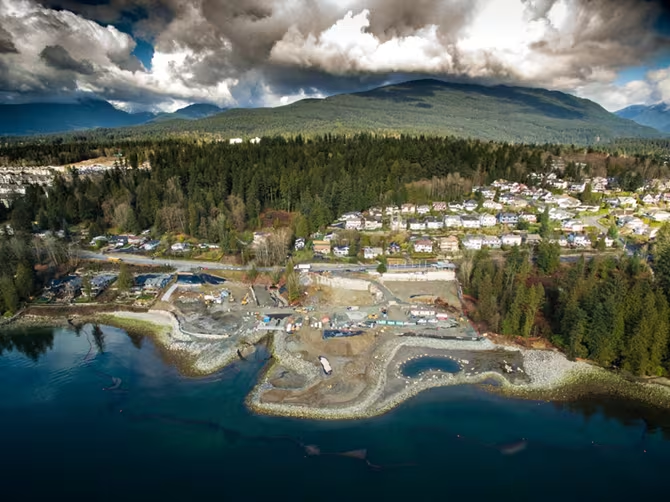
Remediation and Habitat Restoration for Waterfront Residential Redevelopment
| Location | North Vancouver, BC |
| Client | Polygon Developments |
| Service | Environmental Site Assessment, Risk Assessment, Remediation Program, Fish and Fish Habitat Assessment, Regulatory Submission, Environmental Management |
Key Stats
- Former shipyard lands redeveloped into waterfront housing
- Foreshore habitat restored
- Marine dredging avoided through risk-based assessment
Two former shipyard properties on the North Shore of Burrard Inlet were set to become a new waterfront residential community. Decades of shipbuilding, sandblasting, and wood treatment had left behind widespread contamination in soil, groundwater, and sediments on a site directly adjacent to a major public park and within the Traditional Territory of the Tsleil-Waututh Nation.
Before redevelopment could proceed, Polygon Developments needed a solution that addressed contamination while also restoring the foreshore environment. The challenge was not only technical complexity, but also coordination as site operations continued during investigation and multiple regulators and stakeholders were involved.
PGL supported the project from assessment through approval, completing contaminated site investigations, risk assessments, and remediation planning alongside the design of a foreshore habitat restoration program. Working with engineers and regulators, PGL helped integrate remediation and habitat enhancement into a single, efficient approach.
Risk-based assessments demonstrated that large-scale subtidal dredging was unnecessary, allowing the project to avoid costly and disruptive marine remediation while still protecting ecological and human health. Habitat restoration designs met port authority requirements and improved shoreline function.
Through this integrated approach, the site transitioned from industrial legacy to livable waterfront. The project balanced redevelopment, environmental protection, and habitat restoration in a highly sensitive setting.
Two former shipyard properties on the North Shore of Burrard Inlet were set to become a new waterfront residential community. Decades of shipbuilding, sandblasting, and wood treatment had left behind widespread contamination in soil, groundwater, and sediments on a site directly adjacent to a major public park and within the Traditional Territory of the Tsleil-Waututh Nation.
Before redevelopment could proceed, Polygon Developments needed a solution that addressed contamination while also restoring the foreshore environment. The challenge was not only technical complexity, but also coordination as site operations continued during investigation and multiple regulators and stakeholders were involved.
PGL supported the project from assessment through approval, completing contaminated site investigations, risk assessments, and remediation planning alongside the design of a foreshore habitat restoration program. Working with engineers and regulators, PGL helped integrate remediation and habitat enhancement into a single, efficient approach.
Risk-based assessments demonstrated that large-scale subtidal dredging was unnecessary, allowing the project to avoid costly and disruptive marine remediation while still protecting ecological and human health. Habitat restoration designs met port authority requirements and improved shoreline function.
Through this integrated approach, the site transitioned from industrial legacy to livable waterfront. The project balanced redevelopment, environmental protection, and habitat restoration in a highly sensitive setting.